

There it is, buttering the carpet, falling into its rising: light.
The window that welcomes this light is circular. It is moon-shaped, pearl-shaped, freckled with dust. On the other side, a garden. It looks over a street. Feathered creatures fly through it. A smattering of stones, concrete paths, grass guarding soil. A scruffy-haired tree combed by wind.
Hello, you say.
Hello, I say.
We trade names.
Beyond us, the tender bleat of a currawong, touching everything.
*
You tell me you are from Sri Lanka. I tell you my family is from Aotearoa—the land of the long white cloud.
You speak of coconut palms. Those coconuts, so round and green ion great bunches, suspended in sky before they tumble, spin towards ground.
There are no coconut palms in Aotearoa.
For a brief second, I imagine them sprouting by the strawberry bushes outside my old house—the house that sheltered my whanau in Tāhuna. I imagine my baby brother peering out at them, dimples brightening, waving at the coconuts the way he used to wave at the mountains, thinking they were elephants. That gentle smile, those little hands.
*
The nature of life, Buddhist poet Richard Von Sturmer writes, it’s putting out the rubbish and recycling bins on a Monday evening and taking the clothes off the line when the sky becomes overcast11.
Also the nature of life: In Cornwall Park, an elderly Japanese man takes off his dark glasses to photograph the cherry blossoms22.
*
The sun is bright as a lemon. I close my eyes under the fizz of it. It is lapping like tide against the window, warming glass, gathering in our laps. The tree outside is sucking on it. Her leaves blush saffron. And the currawong, the currawong sharing flute sounds with air.
You tell about the times when rain would fall, oceans away in Sri Lanka, and strangers would huddle under each other’s eaves to keep the sky from soaking them. I picture pebbles of rain dropping onto fig trees, decorating leaves, making the earth all pulpy. The sound of shared laughter as rain tickled the tips of noses.
*
That time my mum drove past an elderly man on the cusp of falling—
He wore a cap shaped like an acorn. An azure suit. His eyes were kind, and his shoulders were curled, arching towards his chest.
No one stopped to help him.
Not the bikers whizzing through the morning like comets.
Not the phone-bowed teenagers, ears stuffed with headphones the colour of fresh snow.
Not the dog walkers bounding along the path, moving swiftly, steadily, canine-breath unspooling in fairy-floss tufts.
No one.
So my mum, I tell you, my mum stopped the car. She flung the doors open. She didn’t care if she parked messily, if she got a ticket, a fine, because that man was alone, wibbling and wobbling on the street, so close to falling.
She got there just in time.
She cupped and cradled his arm, and walked with him towards a bench. His arm was fragile under his dress suit, like the wing of a bird.
You must have no job, he said, if you come over to see if I am okay—if you come over to stop me falling. That’s why they don’t stop, these people, he said. Because they all have jobs to go to.
*
You can still connect with people, you say. Even without words.
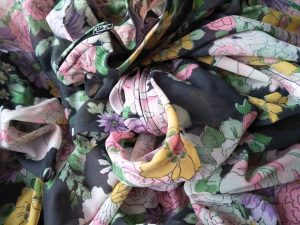
You are part of a women’s sewing group. You mend holes in your clothes and stitch torn fabric back together again, and make new clothes too. We admire each others work, colourful fabrics and patterns. Some are so very accomplished.
Surely, I say, threading a needle back and forth, forth and back, is a form of meditation?
Yes, you say. A way to tame the monkey mind.
The monkey mind, which is to say the restless, whirring mind, caught in a swirl of constant inner chatter.
The monkey mind stops you from being present, you say. It stops you from being here.
When light falls across a field, when sea massages shore, exhaling foam, and the mind leaps between yesterday and tomorrow, what is and what is not. The I must bake bread before the dawn breaks and if only the kitchen were painted a softer shade of blue and perhaps I should train myself to smile at the sky, forgive the wind.
Taming the monkey mind is a lifelong practice, you say. Little by little, bit by bit, we can remember what it is to be here.
And there it is, trumpeting again, freed from throat into world—the call of the currawong.
*
There is strength in wonder, Richard Von Sturmer writes. We gain strength by watching horses running in a field, and by walking along the foreshore at sunset with each volcanic rock glowing in the sand. Here is my heartbeat33.
*
You are about to embark on a silent retreat. In the country, you say. With mountains and trees. A view of sky.
Will there be others there with you?
Yes.
But you can’t talk to them?
That is right.
And I wonder how loud the birds will be, with no human voices to blanket them.
*
Walking away from you, parting beneath a streetlamp, I think of the women in Scotland—the women who worked the tweed.
They would gather around a luathadh—a hard surface, a table—and sing songs as their hands massaged the cloth, as the light shifted in the sky above their heads.
The songs they sung were not without sadness.
One, Gura Mis’ Tha Fo Èislean, tells the tale of a woman, parted from the man she loves.
She rises early, in the apricot-coloured hours of dawn-break, to watch a deer and her mate prance together through the fields. Gold hills hold the sky up. The deer, her hoofed love, pausing for a moment to let their muzzles meet. Breath passes between them like letters.
If only, the woman laments, I could spend a week in the body of a seagull, a goose, a mallard—any form with feathers.
S mi gun snàmhadh cuan farsainn, she sings. Soaring across the wide ocean… 44
*
You have walked sacred paths. Ochre roads ringed with flowers the colour of pearls. I find myself following, Richard Von Strumer writes, in the footsteps of the World Honoured One55.
You show me temples, ancient shrines gilded with gold, hills cuddling clouds, so close to the stars. We travelled by bus, you say. We could not walk it all on our own feet, the tens of thousands of kilometres!! And I think of a poem, a poem woven by Sosei, a Japanese poet and Buddhist priest: as one turns about the moon / understands one’s very heart66.
Pilgrimage, meaning across the fields.
Pilgrimage, meaning to set out across land and life in search of sacredness.
We are in a cafe courtyard. It is populated by pigeons. They lunge at sandwich crumbs, porcelain plates, the remnants of lamingtons, sponge cakes. Such brazen bravery. Beyond the pigeons, bonsai trees. They sleep in grey vases. Pines, poplars, a fraction of the size they could have been. Bonsai trees always make me sad, I say. I sometimes wonder if they long to be bigger than what they are—as big as they were made to be.
After a while, the pigeon sounds start to soften. Or perhaps they have not softened, but we have, training our attention to rest on each other’s voices.
*
After a long retreat, Richard Von Stumer writes, you come out into the world. The colours are so bright—but they’ve always been that way77.
*
If you can get through the second day, you say, you can get through it all.
You have recently returned from a silent retreat. For ten days you rose early, before dawn could open her golden eyes, and passed the seconds walking, meditating, eating, exhaling, breathing slow and soft into daylight.
There were others with you—others amongst the mountains and trees.
I ask you what it is to connect with people when you cannot talk to them. No jokes, no how warm is the weather today or this wind, isn’t she wild or you must come visit me, this Monday or the next, and we shall drink tea together under the fluorescent crown of a mulberry tree.
But there could be gazes. Fingers signalling. The occasional bloom of laughter, dissolving in air like butter over a stove.
*
I have a moth infestation in my cupboards! I tell you. All these winged things nibbling on my dresses. A beat. So instead of reading my book, or walking through the park, trying to tame my monkey mind, I must spend the rest of the afternoon on my hands and knees with a bottle of vinegar, brushing the moth eggs away.
And we laugh, shake our heads, the pigeons stirring above our heads.
The nature of life, we say. The nature of life!
What you show me next floods me with feeling. It sends bright colours into my chest. Look, you say. Your voice steers the word into world gently, measuredly, like something precious. The Bodhi Tree.
Bodhi, deriving from ancient Sanskrit and Pali, meaning awakening, enlightenment.
The Tree under which Prince Siddhartha, in Bodh Gaya, India made his seat; and, seeking answers, the source of human suffering, became enlightened.
He stayed 49 more days, sitting and walking, honouring and contemplating, paying homage to the place and the sacred tree and all he had discovered beneath it.
You talk of the Bodhi Tree in the city of Anuradhapura, Sri Lanka. It is an ancient being—the oldest living tree planted by human palms. Still, after more than 2,500 years, a fleet of sunrises and sunsets, it arches skyward. Its leaves court sun. A marble Buddha shelters amongst its roots.
The Tree grew from a branch of the sacred Bodhi Tree in India—the tree under which Siddhartha became enlightened. It was carried by Sangamitta, a Buddhist nun and princess, daughter of the Indian Emperor Ashoka, in a golden vase.
When it reached the shore, the Bodhi branch is said to have risen into the air. It blessed the land with light: Hardly had [the King] let it leave his hands but it rose up eighty cubits into the air, and floating thus it sent forth glorious rays of six colours. Spreading over the island, reaching to the Brahma-world, these lovely rays lasted till sunset. Ten thousand persons…were filled with faith by reason of this miracle88.
*
We have almost finished our cake.
(Oh! We are full of cake!)
The pigeons, stretching their concrete-coloured wings, ponder the possibility of vacuuming the crumbs with their beaks.
I remind you of something you told me, the very first time we met: At the end of every sadness, there is a happiness.
You insisted they were not your words—They are the words of the Buddha, the one who became enlightened by the base of the Bodhi tree—but you spoke them in a way that was true, and kind, and lived.
Beyond the window, buoying above cars and streetlamps, blue and red bikes, the currawong. She was sending out soft sounds. She almost seemed to be singing to you. Your cadence and her cadence, her bird language and your human language, lozenging the slow lilt of the afternoon.
*
What is it like, I ask you, to meditate beneath the Bodhi tree?
Oh! you say. Eyes alive with light. Like nothing else. A beat. There is nothing else in the world like it.
The beloved Bodhi Tree is nestled within an open-air temple. Its limbs are supported by golden rods. When I was there, you said, I watched a long line of monks in bright robes walk towards it, chanting. It was so beautiful, seeing all that colour; all that orange passing by.
You had wanted to take a photo. There it was, perched in your palm, the device with the power to capture light, a slice of time. But you did not. Perhaps you were worried the monks would see you, watching with wide eyes, a sudden silhouette. Or perhaps you had wanted to be here—with soil, with sky, the attentive gait of your gaze—and not there, within a phonescape, so far from all that colour; all that orange passing by.
*
The leaves that sprout from the Bodhi tree are shaped like hearts. They can be used to treat fevers, skin diseases, asthma. I wonder how many leaf hearts have unbuckled from the branches, lush with light, and fallen upon the heads of those meditating beneath—so small, so silent, so much like blessings. Even a little staple hole, Mary Ruefle writes, may be the beacon which will light up the truth99.
*
In Scotland, the snow falls like starlight. It greets the land gently. I remember standing before it, many moons ago, a hot and impossible sadness chasing the light from my eyes, wanting to press my cheek against it.
Cadal ciarach mo luran…Chan fhaigh dròbhair a’ chruidh thu…bidh mi fhìn agad tuilleadh, an old Gaelic lullaby whistles1010. It is a lullaby traditionally sung by a mother to her daughter, a mother to her son, while night settles over the moorland like a second sea. Sleep well, my darling, sleep well…the cattle drover will not get you… I will always be with you1111.
*
I wish I told you about a Māori word—the Māori word for love.
Four words within the word for love: Aro, Ro, Hā, Oha1212.
Aro, meaning to face towards.
Ro, meaning within.
Hā, meaning breath.
And Oha, OHA, meaning generosity, abundance, prosperity.
Ko te Mauri, he mea huna ki te moana, a Māori whakataukī, a wisdom phrase, reminds us. The life force is hidden in the sea1313.
In the sea, in the currawong, in the pigeons that came to rest on the table, devouring cake crumbs, after we had set off on our separate quests through the golden-hour—to water the garden, to tend to the moths, the holes in the roof, hā swirling all around us, here and here and here—
Many dusks have passed since we sat by the circular window, since we shared cake in the courtyard, watched the pigeons whirl. But I repeat your words, the Buddhas’s words, every time I feel the wind pick up, the worry rush in, rioting against breath: At the end of every sadness, a happiness.
And just like that, there it is—sliding through the seconds, softening the seasons: light.